


Mastering Common-Mode Rejection with the FLC101 and ADS1115
For the DIY treasure hunter, there is no greater adversary than the “phantom signal.” You’re out in the field, your equipment is calibrated, but then the soil mineralization shifts, the morning dew settles, or the midday sun triggers thermal drift in your components. Suddenly, your steady baseline becomes a jittery mess of “noise.” In the world of high-sensitivity detection, these environmental instabilities are the line between a successful find and a day wasted chasing ghosts. To move past these amateur headaches, we have to look at how professional-grade hardware handles data. By pairing the FLC101 fluxgate sensor with the ADS1115 analog-to-digital converter (ADC), we can implement a sophisticated configuration that virtually erases the static.
The Secret Sauce: Why Differential Measurement Defeats Noise
The primary reason most DIY builds suffer from instability is a reliance on “Single-Ended” measurement. In this standard setup, the ADC measures the voltage of a single sensor pin relative to the system’s ground (GND). It is simple, yes, but for sensitive metal and cavity detection, it is often a fatal flaw. Any electromagnetic interference or “noise” picked up by the wiring is baked directly into your readings, corrupting your data beyond repair.

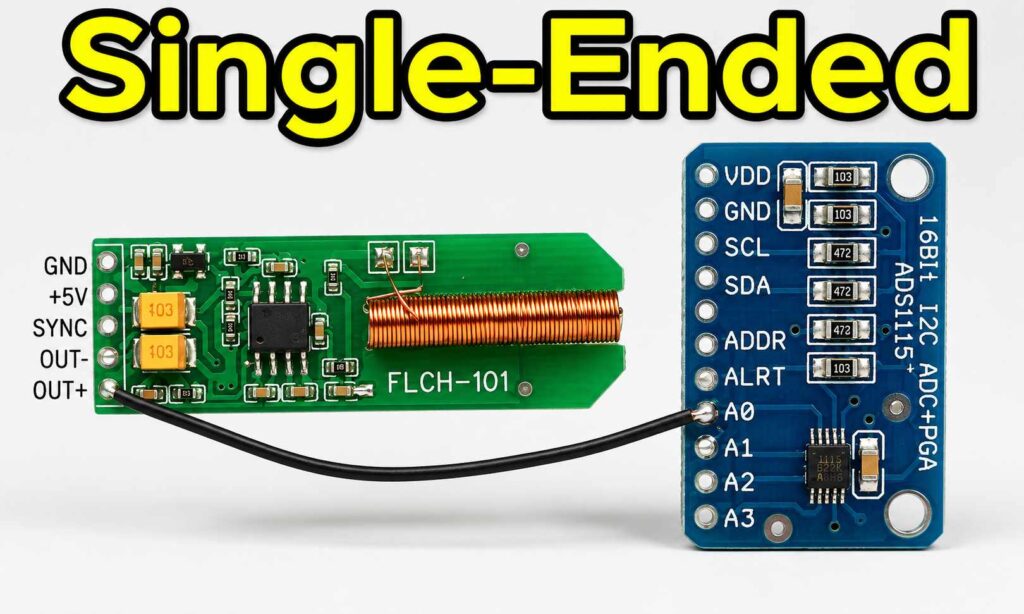
The breakthrough is shifting to “Differential Mode.” This is where the real engineering begins. Instead of referencing the messy, fluctuating system ground, the converter measures the voltage difference between two dedicated channels. It ignores the GND pin entirely.

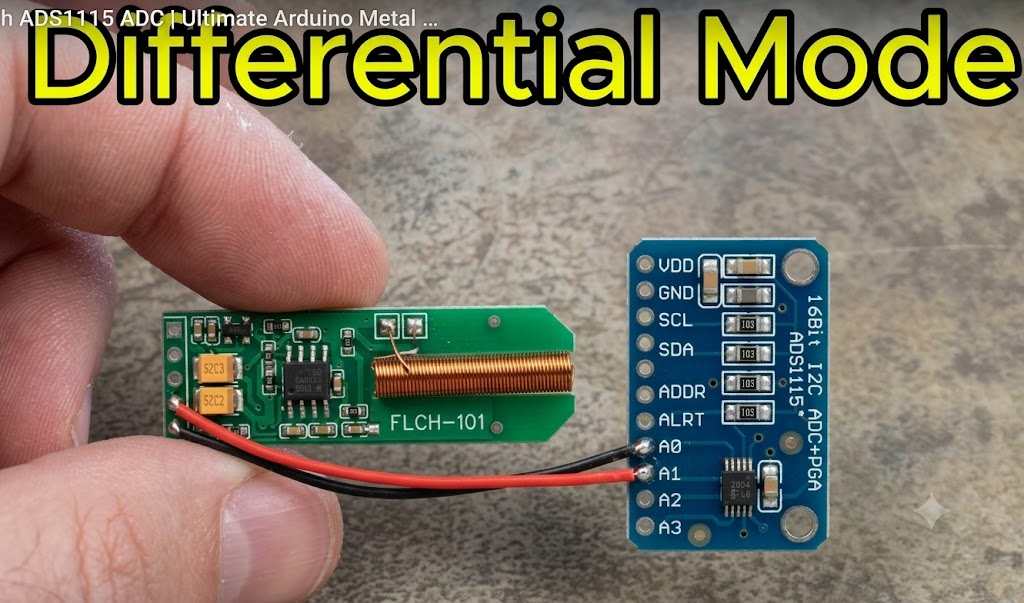
This is “the real magic” of signal processing. The logic is elegant: if external noise hits your cables, it typically strikes both wires simultaneously with the same intensity. By measuring the difference between the two, the ADS1115 intelligently subtracts the shared noise, leaving only the pure, crystal-clear signal from the sensor. In the industry, we call this common-mode rejection, and it is the key to a rock-solid baseline.
The FLC101 Architecture: Why Differential Wiring is Non-Negotiable
While the FLC100 series is famous in the DIY community, the FLC101 is the specific model engineered to shine in a differential environment. To unlock its potential for absolute precision, you must respect its hardware design. The sensor provides two primary outputs—Out+ and Out-—which are intended to be read as a pair.
The Professional Wiring Logic:
- Out+ Pin: Connect to channel A0 on the ADS1115.
- Out- Pin: Connect to channel A1 on the ADS1115.
By bypassing the traditional ground reference, you eliminate the risk of ground loops and voltage fluctuations that plague amateur setups. This specific wiring allows the ADC to capture the net magnetic voltage difference with microscopic accuracy. The result is a system that can finally ignore the “static” caused by soil moisture or heat, maintaining stability where other sensors would fail.
The Gain Factor: Strategic Resolution over Headroom
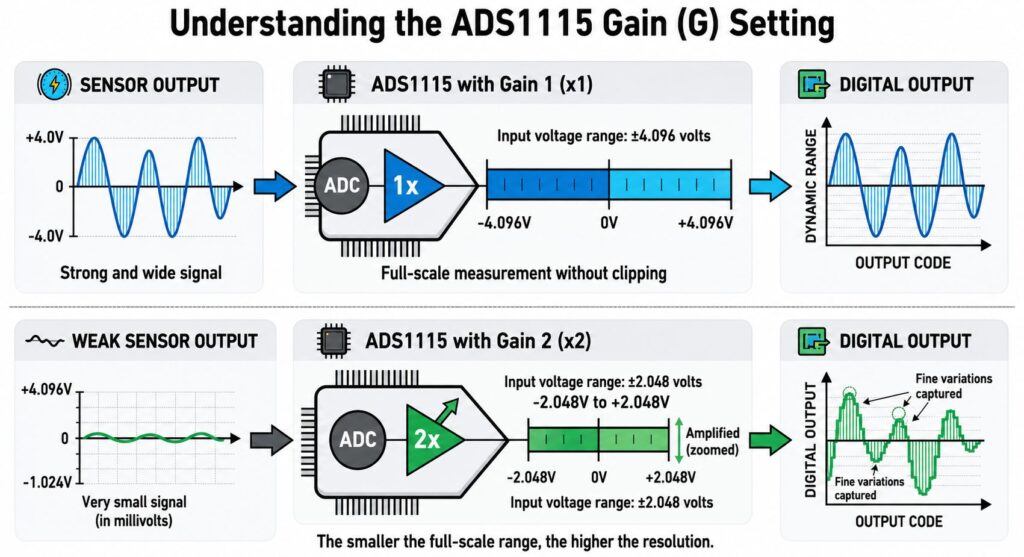
Once your wiring is optimized, the ADS1115 offers one more professional tool: the Programmable Gain Amplifier. Think of this as a magnifying glass for your electronic signal. However, utilizing Gain is a strategic trade-off—you are sacrificing “headroom” (the maximum voltage range) for microscopic resolution.
Navigating the Gain Settings:
- Gain 1: This provides a wide window of ±4.096V. Use this when your sensor is over a high-contrast target and the signal is already robust. It ensures the full signal is captured without clipping or distortion.
- Gain 2: This acts as a 2x optical zoom. The window narrows to ±2.048V, but the sensitivity of your system effectively doubles.
By choosing Gain 2, you enable the system to catch tiny, millivolt-level fluctuations that a standard detector would simply ignore. It allows you to “see” deeper into the soil by amplifying the smallest differences in the magnetic field, providing the resolution required for deep-earth cavity mapping.

From Amateur Static to Scientific Clarity
By implementing Differential Mode and optimizing your Gain settings, you are doing more than just building a tool; you are graduating from a “toy” detector to a scientific instrument. These technical adjustments shift the focus away from environmental interference and back to what actually matters: the target beneath the surface.
Now that the noise is gone and the signal is pure, the question is no longer whether your equipment can handle the environment, but what hidden discoveries have been waiting for someone with the clarity to find them. What lies beneath your feet once the static is finally silenced?