


I’d like to share my latest project — a USB programmer for AT89Cx051/AT89C5x microcontrollers, built on what is probably the most well-known and inexpensive development board out there: the Arduino Nano.
The programmer’s circuit is fairly simple. Besides the Arduino board itself, it contains a couple of transistors, a diode, several resistors and capacitors, a crystal oscillator, and two very popular 74HC595 serial shift register chips.


Circuit diagram
I built the circuit on a breadboard, with separate configurations for microcontrollers in the 20-pin package (AT89C1051/2051/4051) and the 40-pin package (AT89C51/52). For programming the 20-pin microcontrollers, only the upper part of the circuit is needed (without the 74HC595 registers).
The 12-volt supply can be provided either from an external power source or from a boost converter, in which case the programmer can be powered solely through the Arduino board’s USB port (I used one of the cheapest MT3608-based DC-DC converters for testing, and it handled the job perfectly).
The firmware for the Arduino — or more precisely for the ATmega328 — is written in C, so the hex file needs to be flashed using bootloader programs like “Arduino uploader” or similar tools via the standard USB connection. The Arduino’s own bootloader remains intact, so the board can later be reused for any other purpose.
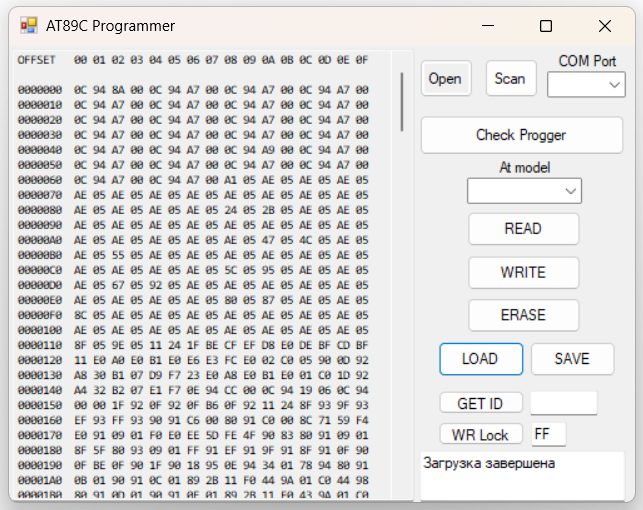
The PC-side software is written in C# and is Windows-only. It has no complicated settings — you just need to select the correct COM port and the microcontroller model you want to program.

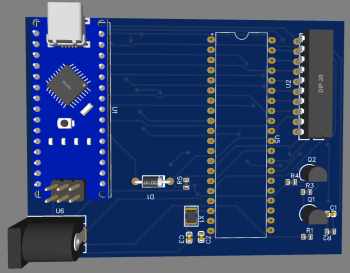
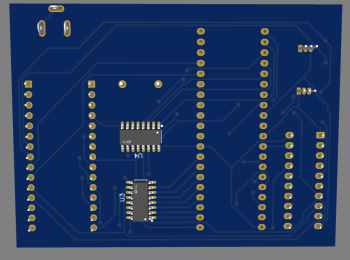
I didn’t actually make a physical PCB for the programmer. However, since I drew the schematic in EasyEDA, I generated a possible board layout using the auto-router (I didn’t verify its correctness — it was made just for illustration purposes). The PCB files are attached to the article in the archive. Here’s what the generated programmer board looks like without the DC-DC converter:


The programmer has been tested and verified on the AT89C2051 and AT89C52 microcontrollers. The first one I tested not only with the programmer itself for read/write accuracy, but also in a real device (a clock).
All files (schematic, firmware, software, board layout) are attached to the article. The files will also be available for download on GitHub.
Bill of Materials
| Designator | Type | Value | Qty | Notes | Store |
|---|---|---|---|---|---|
| U1 | Arduino Board | Arduino Nano 3.0 | 1 | Search in Otron store | |
| U3-U4 | Shift Register | SN74HC595 | 2 | Search in Otron store | |
| D1 | Diode | 1N5918 | 1 | any Schottky | Search in Otron store |
| R1, R3 | Resistor | 1 kΩ | 2 | Search in Otron store | |
| R2, R6-R13 | Resistor | 10 kΩ | 9 | Search in Otron store | |
| R4 | Resistor | 4.7 kΩ | 1 | Search in Otron store | |
| R5 | Resistor | 2.2 kΩ | 1 | Search in Otron store | |
| C1 | Capacitor | 100 nF | 1 | Search in Otron store | |
| C2, C3 | Capacitor | 12 pF | 2 | Search in Otron store | |
| X1 | Crystal Oscillator | 12 MHz | 1 | Search in Otron store | |
| Q1 | Bipolar Transistor | BC547 | 1 | any low-power NPN | Search in Otron store |
| Q2 | Bipolar Transistor | BC557 | 1 | any low-power PNP | Search in Otron store |
Download files
This content is available to logged-in users only.
هذا المحتوى متاح فقط للمستخدمين المسجلين.
Ce contenu est réservé aux membres connectés.
🔑 Login 📝 RegisterLog in or create a free account to access downloads and exclusive content.