


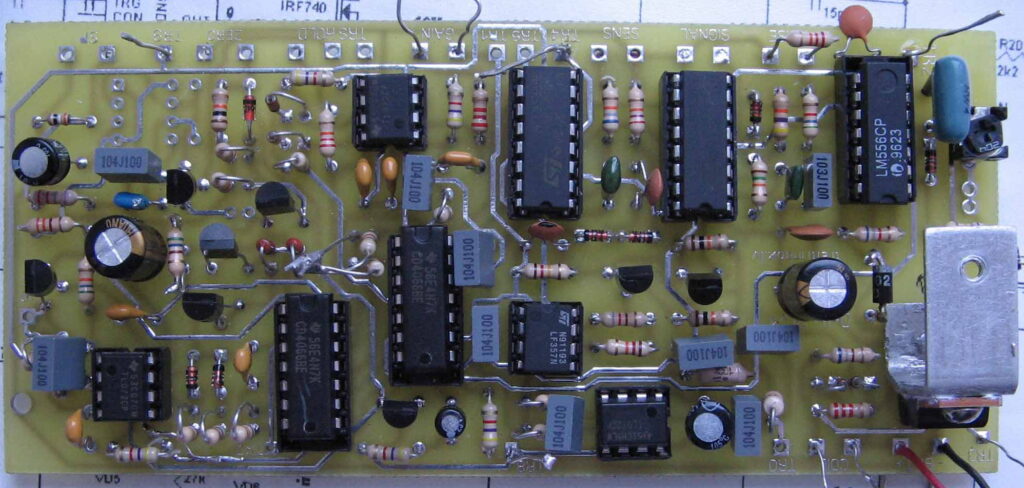
Delta Pulse – Bulgarian Pulse Depth Detector
The device operates by amplifying and registering weak signals after a powerful probing pulse, using two strobe signals instead of one. This method helps reduce the influence of the ground, which is particularly challenging in Bulgaria due to heavy soil conditions.
The “Delta Pulse” is a pulse induction metal detector designed to locate large, deeply buried metal objects. It operates on the principle of pulse induction, which is particularly effective in detecting objects at great depths.
Key Features:
- Operating Frequency: 100 Hz
- Adjustable Settings: Includes power and pulse density, sensitivity, and audio threshold adjustments.
- Interference Elimination: Capable of tuning out potential interferences from radars, power lines, and powerful radio transmitters.
- Reset Button: Allows for quick restoration of the system to its initial settings for different terrains.
- Automatic Temperature Adjustment: Automatically adjusts to changes in temperature.
- Battery Check Button: Allows for checking the battery status.
- Depth Detection:
- Objects 10×10 cm can be detected up to 1 meter deep.
- Objects 25×25 cm can be detected up to 1.7 meters deep.
- Objects 50×50 cm can be detected up to 2.5 meters deep.
- Objects 1×1 meter can be detected up to 3.5 meters deep.
- Larger objects can be detected up to a maximum depth of 4 meters.
- Power Supply: Powered by a 12V rechargeable battery, with an automatic charger included in the package. The operating time on a single charge is approximately 10 hours.
- Additional Options: Can be equipped with larger search frames (2x2m or 3x3m) for increased detection depth by 20-50%, reaching depths over 5 meters.


Key components and their functions:
- Oscillator: Generates the signal for all strobes and adjusts the amplifier’s settings to “0” before all pulses. The pulse frequency is set to avoid industrial noise, typically around 108 Hz.
- Strobes: Two strobes are used, with adjustments made to suppress interference from nearby metals or large metal objects.
- Coil: The coil’s design is optimized for the size and resistance needed, though the author notes challenges with different coil sizes.
- Amplifiers: The input amplifier strengthens the signal from the coil and manages strobe positioning during overload. The main amplifier is responsible for the device’s sensitivity, which needs careful adjustment to avoid overload.
- Detector: The detector circuit is considered the most sensitive part of the device. It manages signal detection, logarithmic amplification, and auto-balancing of the device.


Modifications: The author suggests various modifications to improve the device’s performance, such as using a detector with memory and adding more precise operational amplifiers.
Final Remarks: The author shares personal experiences with the device, mentioning potential issues with components and usability.